
Claiborne Criminal Court Records
A criminal court record is the case-level file kept once a prosecution enters the court system. In Claiborne Parish, the Clerk's Online Records Access page specifically includes criminal records, and the staff directory assigns criminal, juvenile, and non-support questions to criminal staff. Civil and criminal minutes are also named as a staff area. Those local details show that criminal case access is handled through the Clerk, not by using the jail roster alone.
The local trial court is the Second Judicial District Court in Claiborne Parish. It handles district-court criminal matters filed in the parish, while the same judicial district also serves Bienville and Jackson Parishes. A Claiborne filing is searched through Claiborne Parish records unless the case was filed or transferred elsewhere. Lower courts may handle local traffic, ordinance, or bench-warrant matters, but district-court criminal case files are the main source for felony prosecutions and other criminal matters filed at that level.
Search Claiborne Criminal Cases
The first online route is the Claiborne Parish Clerk's online records access path through Clerk Connect. The public research confirms paid access options and document-image printing, but it does not show every criminal-search field available after login. Searchers should use the defendant's exact name, case number if known, filing date, and criminal case type where the module allows it. When a criminal minute or older file is not found, the Clerk's criminal and minutes staff are the fallback.
- Open the Clerk's online records access page and proceed to Clerk Connect.
- Log in with an active account, then choose the criminal records module if available.
- Search by defendant name, case number, filing date, or other available module fields.
- Review the docket or minute entries for arraignment, motions, pleas, disposition, and sentencing events.
- Request copies from the Clerk when a certified criminal court record or full document image is needed.
Sheriff records may be needed for an arrest report or booking detail, but that is not the same file. The court charge records page focuses on the arrest-to-filed-charge path, while this criminal court records page focuses on the full case after filing.
Criminal Case Flow
Criminal court records change as the case moves. A booking charge may be reviewed by the district attorney, a filed charge may be amended, and a count may later end in dismissal, plea, trial verdict, or sentencing. The court file is the best source for the court's current version of the charges and outcome because it reflects filed pleadings, minutes, and orders.
Case flow: Charges Filed › Arraignment › Pretrial / Motions › Plea or Trial › Disposition › Sentencing
| Stage | What Happens |
|---|---|
| Charges filed | The prosecutor files a charging document that opens or advances the criminal case in court. |
| Arraignment | The defendant is formally advised of the charge and enters a plea. |
| Pretrial / motions | The parties file requests, set hearings, exchange issues, and seek rulings before trial or plea. |
| Plea or trial | The case is resolved by plea, bench or jury trial, dismissal, or another court-approved outcome. |
| Disposition | The court record shows the final or current status of each count. |
| Sentencing | The court orders jail or prison time, probation, fines, costs, restitution, or other conditions after conviction. |
What Criminal Records Show
A Claiborne Parish criminal court record may contain the charging instrument, arraignment entries, pleas, motions, hearing settings, minute entries, trial information, disposition, sentencing order, probation terms, fines, costs, and appeal activity. It may also show attorneys, bond entries, continuances, and court costs. A single case can have several counts, and each count can have a different status or outcome.
| Field | What It Shows |
|---|---|
| Case number | The court identifier used by the Clerk and printed on notices or filings. |
| Defendant | The person charged in the criminal case. |
| Charges | The counts filed with the court, which may differ from booking labels or initial arrest notes. |
| Arraignment / plea | The formal advisement of charges and the defendant's plea entry. |
| Motions and hearings | Requests, hearings, continuances, rulings, and trial settings. |
| Disposition | The outcome for each count, such as guilty plea, conviction, dismissal, or acquittal. |
| Sentence | Probation, jail or prison term, fines, costs, restitution, and court-ordered conditions. |
| Appeal | Whether a higher-court review was sought after an appealable judgment or order. |
Charges vs Convictions
Being charged is not the same as being convicted. A charge is the accusation filed or pursued in court. A conviction requires a guilty plea, verdict, or other adjudication that establishes guilt under the criminal process. A Claiborne Parish criminal court record can therefore show charges that were amended, reduced, refused, dismissed, consolidated, or resolved without a conviction.
| Point | Charge | Conviction |
|---|---|---|
| Stage | Accusation filed or pursued in court. | Outcome after plea, verdict, or adjudication. |
| Meaning | The state alleged a criminal violation. | The court record reflects guilt on that count. |
| Status changes | Can be amended, reduced, dismissed, or nolle prosequi. | Can lead to sentence, probation, fines, costs, appeal, or expungement review. |
| How to verify | Read each count and current status. | Read the disposition and sentence for each count. |
Public Criminal Case Access
Louisiana public-record statutes support access to public records unless another law restricts access. La. R.S. 44:1 defines public records, La. R.S. 44:31 addresses the right to examine public records, and La. R.S. 44:32 covers custodian duties and copies. For Claiborne Parish criminal court records, the Clerk of Court is the custodian for the criminal case file, while the Sheriff's Office handles separate law-enforcement records.
The Claiborne Parish Sheriff's public-records request policy matters because arrest reports and investigative records are often confused with criminal court records.
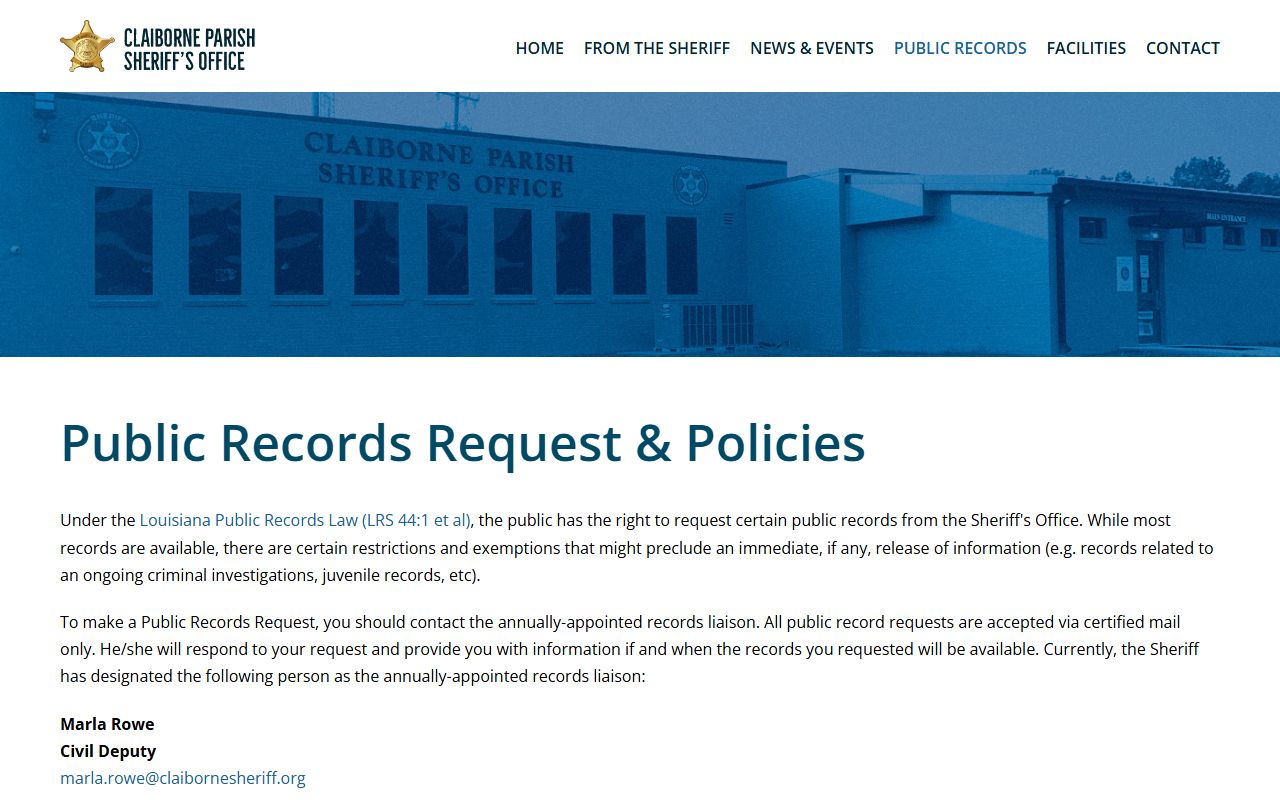
The image helps show the record boundary: sheriff requests can support arrest or report research, but the Clerk remains the source for filed criminal court case records.
The sheriff's policy states that requests are accepted by certified mail only and may be restricted for ongoing investigations and juvenile records. It also lists copy fees for exact pages, redacted records routed through legal counsel, and accident, incident, or 911 address reports. Use that route for law-enforcement records, not for a certified court disposition.
District Attorney Review
The Second Judicial District Attorney serves Claiborne, Bienville, and Jackson Parishes. The DA's role matters because arrest charges become court charges only after prosecutorial review and filing. The DA may accept, amend, refuse, dismiss, divert, or proceed on charges. A jail booking label can be an early law-enforcement description, while the court record shows the filed charge and later status in the case.
The U.S. Attorney's Office for the Western District of Louisiana is a federal prosecution source for criminal-record context outside the parish court system.
This federal source distinguishes local Claiborne Parish prosecutions from federal criminal cases, which use federal courts and federal docket systems.
Sealed vs Expunged Records
Restricted criminal court records require special care. Juvenile matters are identified in local Clerk staff roles, but Louisiana Children's Code confidentiality rules and local public-record policies limit public access. Sealed records are hidden from ordinary public access by law or court order. Expungement generally removes eligible records from public access while some criminal-justice agencies may retain lawful access.
| Point | Sealed | Expunged |
|---|---|---|
| Public visibility | Hidden from ordinary public search by law or court order. | Removed from public access when granted under Louisiana expungement law. |
| Record existence | The record may still exist in court or agency systems. | The record is not necessarily destroyed in every system. |
| Agency access | Allowed when law or court order permits. | Designated agencies may retain access as Louisiana law allows. |
| Local path | Contact the court, Clerk, or attorney for access rules. | File in the court that handled the criminal matter if eligible. |
Louisiana Code of Criminal Procedure article 971 defines expungement in public-access terms. Articles 977 and 978 address misdemeanor and felony eligibility frameworks. The research did not locate a Claiborne-specific expungement fee page, so do not assume a filing fee without checking the Clerk.
Custody Records Are Separate
A person can have a criminal case record and a custody record at the same time, but the two records answer different questions. The court file shows the charge, plea, disposition, and sentence. A jail or prison locator shows custody status, facility placement, or later transfer. For local jail status, use the parish jail roster and custody channels rather than treating a docket as proof that someone is in jail.
The Federal Bureau of Prisons inmate locator is the federal custody lookup source after a federal sentence.
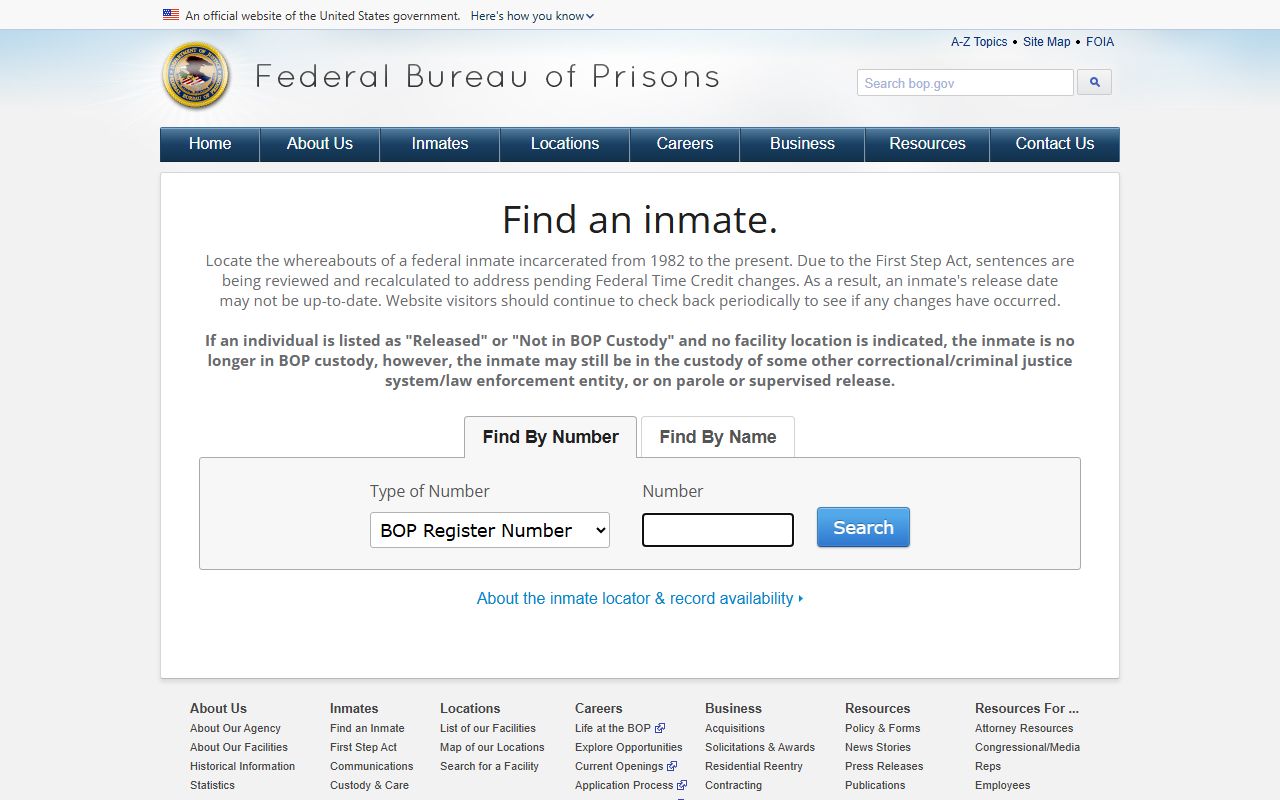
The BOP image marks another boundary: federal prison custody is not the same as a Claiborne Parish criminal court record or local jail roster result.
For current local custody, use the Claiborne Parish inmate records route. For the case outcome, return to the Clerk's criminal court record, minute entries, and sentencing documents.
Note: A criminal court record can show a sentence even when the person is no longer in parish custody.